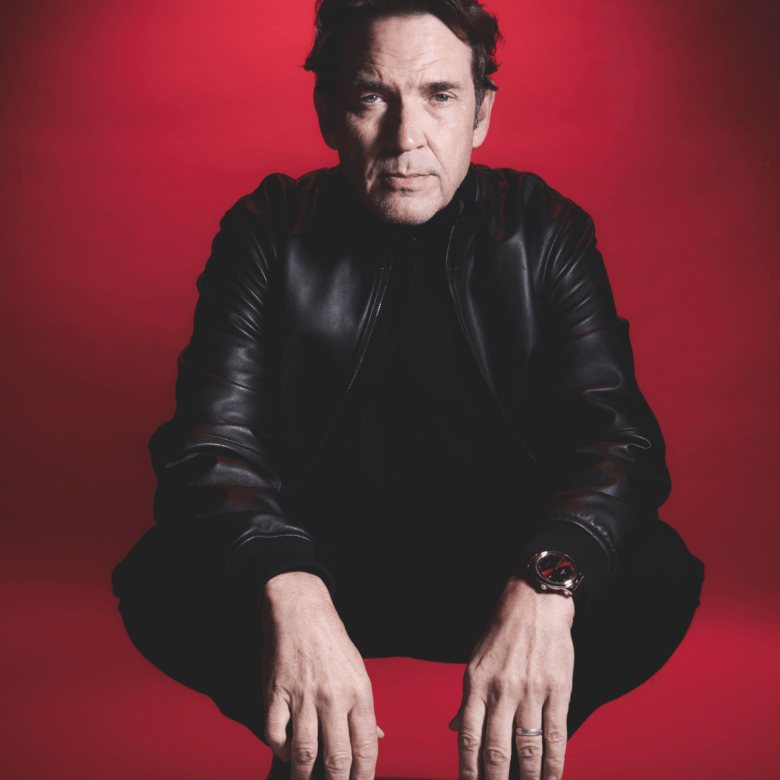
Jack O’Connell keeps his cards close to his chest
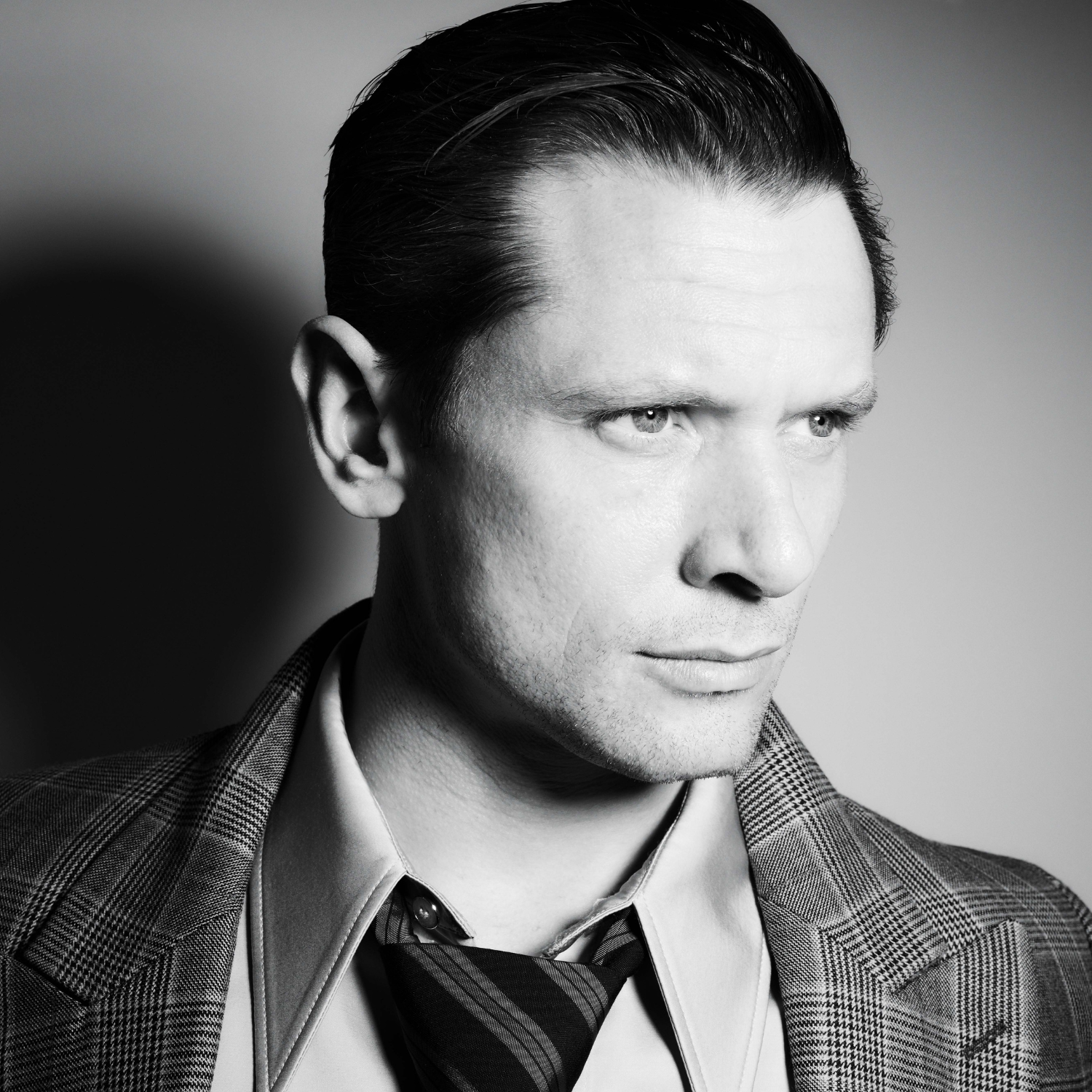
Jack O’Connell is a man who makes his words count. As he speaks to me over Zoom from his house in North London, I find myself pausing at the end of his answers — holding to see if, by letting the silence hang, he’ll give up a bit more information. But when O’Connell has finished speaking, he’s done. There’s a tautness to the way that he talks, one that doesn’t leave room for miscommunication. The English actor is someone who wants to be judged on the worth of what he says, rather than any preconceived notions. In public, he’s hesitant to draw attention to himself. “If I can avoid disclosing what I do, I’d prefer to,” he says. In the pub, he’s claimed a variety of corporate titles to avoid a sudden, artificial spotlight — graphic designers, management consultants — but a white lie that’s close to the truth is always best. “The easiest one to lie about is just to invent another job on set — sometimes I’ve claimed to have been a boom man,” he recalls. “People are still interested, naturally, but it gets you away from the inevitable, Oh, what have you been in? Anything I’d know?”
In some ways, it’s a shame that question is dodged — because the answer is: yes, Jack O’Connell probably has been in something you’d know. Now thirty-five, O’Connell has been gracing screens for the best part of two decades. He booked his first major role as Pukey Nicholls in Shane Meadows’ This is England at fifteen and no more than two years later, starred as Cook in the second generation of Skins — a cultural phenomenon which meant O’Connell’s name was never long out of the papers. Where many actors would seek to double down on their newfound fame and take any and every role that was offered, O’Connell took a more considered route. In the next phase of his career, he split his time between home-grown, independent films and auteur-helmed features. The choice led him to work with directors like Michael Mann, Zak Snyder and Angelina Jolie. But, for O’Connell, no year has been bigger than 2025. He’s starred in two of the year’s most talked about films: playing the charismatic, Irish vampire Remmick in Ryan Coogler’s Sinners and the twisted cult leader Sir Jimmy Crystal in the new 28 Years Later trilogy. Plus, he’s been filming his most blockbuster studio project yet, Godzilla x Kong: Supernova.
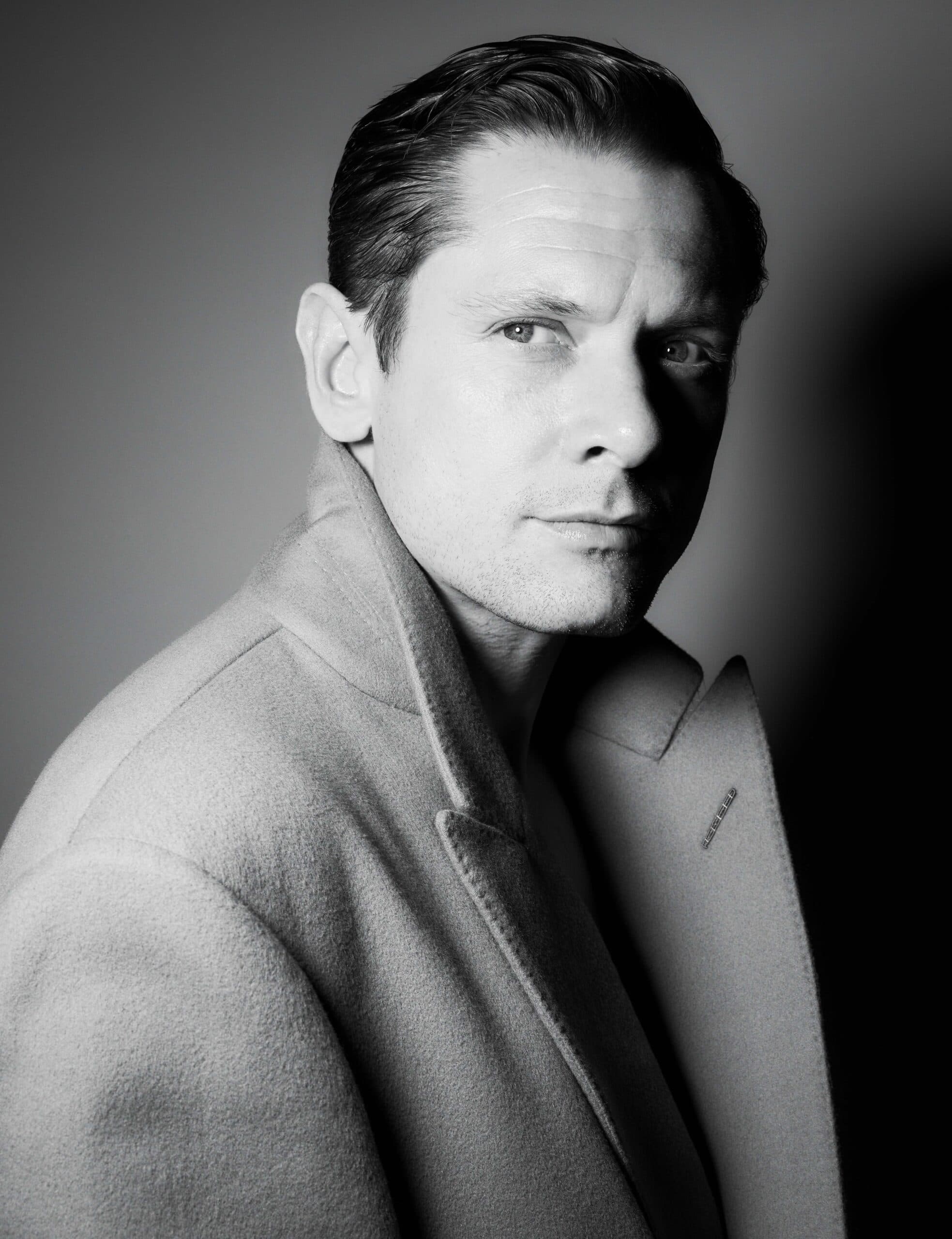
Although O’Connell now feels like a fixture of British culture, his ascent into the public eye ran concurrently with the most vicious period of celebrity reporting. Starring in Skins catapulted O’Connell into tabloid fame and — as with many of his other young castmates — a myth was created around him. His right shoulder was emblazoned with a ‘Jack the Lad’ tattoo that he’d gotten when he was fifteen, he was regularly papped clubbing and he had a propensity for being interviewed hungover. (Skins aired when he was nineteen going on twenty.) These details were spun into a yarn which branded O’Connell — much like his Skins character, Cook — as the bad boy. “Was there sometimes a bit of reality and art informing one another along the process?” O’Connell says. “I think definitely. We were all so young and living this amazing experience in Bristol — which is one of the best cities in the world.”
“I’m not interested in how I’m portrayed — it’s just hot air.”
Although as a culture, we’ve collectively disavowed the reporting tactics of that era, its legacy is not easy to escape. If you are to read an interview with O’Connell, you’ll be hard pressed to find someone who doesn’t ask about this period — trying to glean whether O’Connell truly is the loveable rogue he was made out to be. “I mean — me nana, it pisses me nana off more than it pisses me off,” O’Connell says in his Derby twang. “I couldn’t give two fucks. It’s so long ago now, man.” As he tries to compare the man and the creation, he hits upon a realisation. “Honestly, I don’t know enough about the persona that’s portrayed in the media to be able to compare,” he says. “Partly because I make a conscious effort to swerve it on social media. I’m certainly not interested in how I’m portrayed — it’s just hot air.”
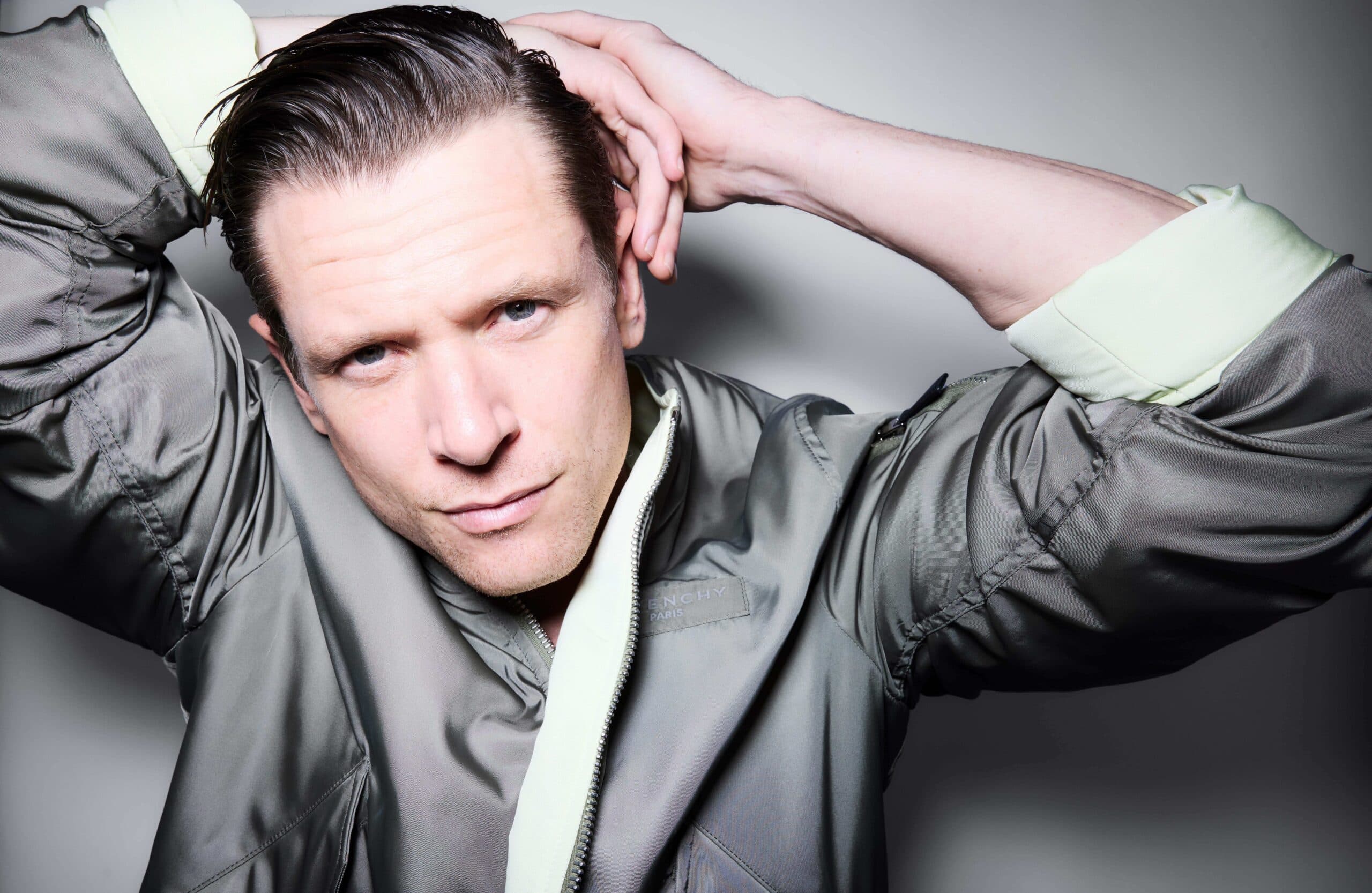

Maybe because of the media attention, or maybe in spite of it, O’Connell has developed an acting philosophy that removes himself from the equation. When O’Connell is asked about his characters in interviews — particularly when he’s asked to interpret their actions or comment on their motivations — he often starts responses with the same phrase: “I think that’s a question for…” before he inserts the name of a director or a writer. At first, this positioning seems slightly self-defacing, as though he feels he isn’t able to answer with as much ownership as a project’s creator, but it more so speaks to a philosophical view on his craft. Actors are “merely conduits”, he says declaratively, with just a hint of a grin. As has become customary during our brief exchange, I pause for him to expand. And, as has become customary, he does not. This is Jack O’Connell’s take on acting — and he’s sure of it.
The next time that O’Connell flexes this philosophy will be when he returns to screens as Sir Jimmy Crystal in 28 Years Later: The Bone Temple. His character is the leader of a Jimmy-Saville-inspired cult and O’Connell has previously described him as a ‘gas cunt’. After making a brief appearance in 28 Years Later — dressed in a purple velour tracksuit, with three thick, gold chains and Saville’s signature shoulder-length bleach blonde hair — O’Connell is set to take centre stage in its sequel. “Obviously, the first character that jumps off the page is Sir Jimmy,” he posits. For many actors, playing a man who is based on the country’s most notorious paedophile would be a hard sell — but not for O’Connell. “I just really wanted to play him. I love the twistedness, the gaiety, that he’s taken from all of the evil.” Playing a villain for villain’s sake wasn’t something that interested O’Connell, though — Sir Jimmy Crystal appealed to the actor because of the multifacetedness of his character. “We get to understand Jimmy’s backstory, we get to know why he’s so dark,” O’Connell explains. “He’s living in a post-apocalyptic world — so, who is anyone to judge? In his world, black is white. Ignorance is strength ,” O’Connell says, before adding, “Please do keep in my George Orwell quote, won’t you? I feel quite smart.”
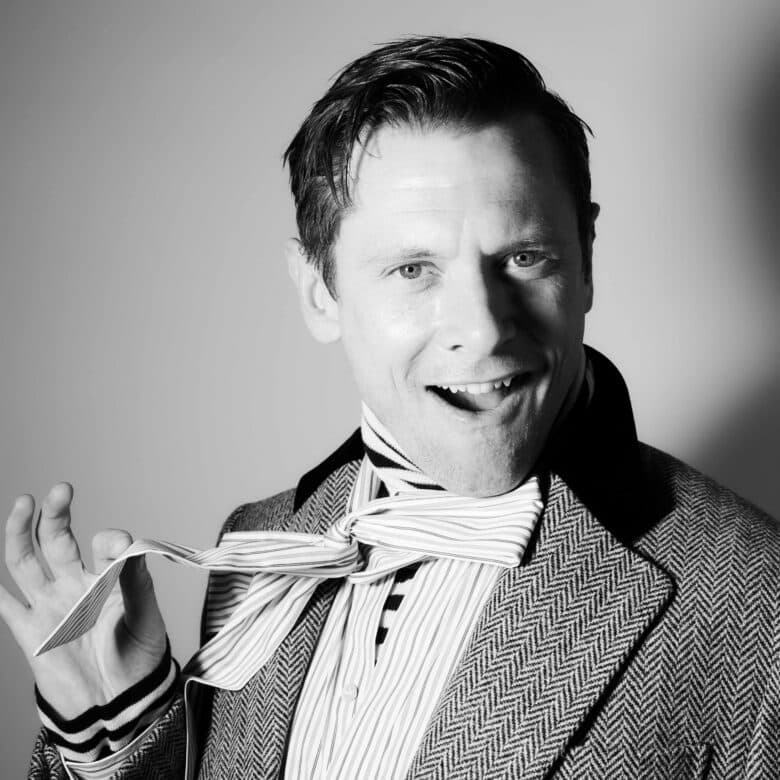
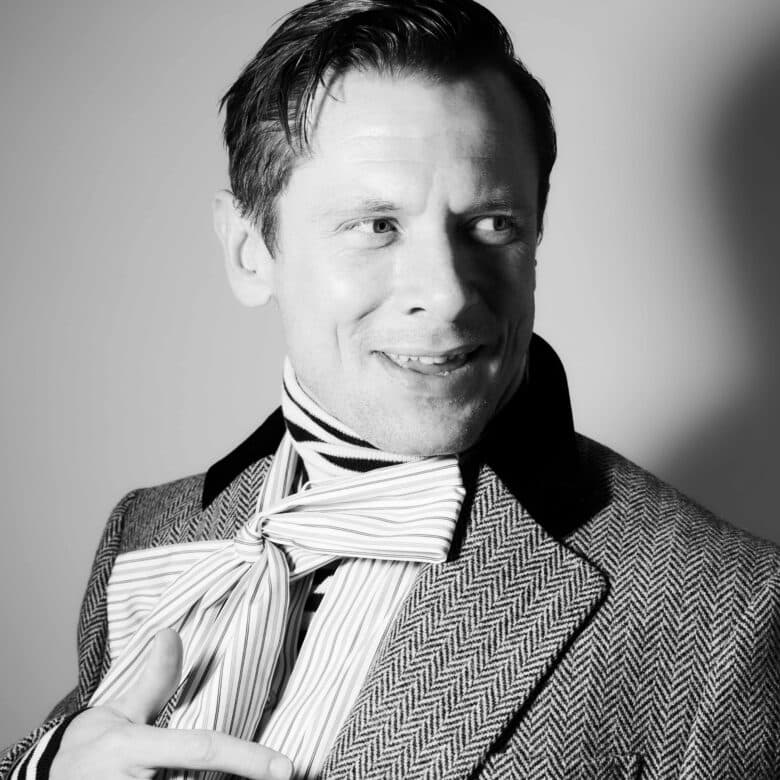
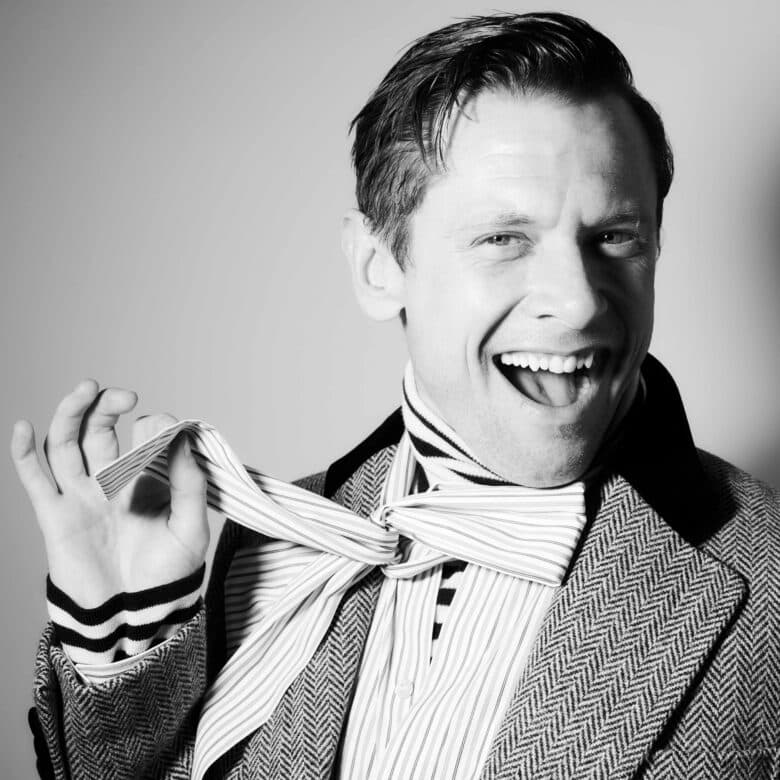
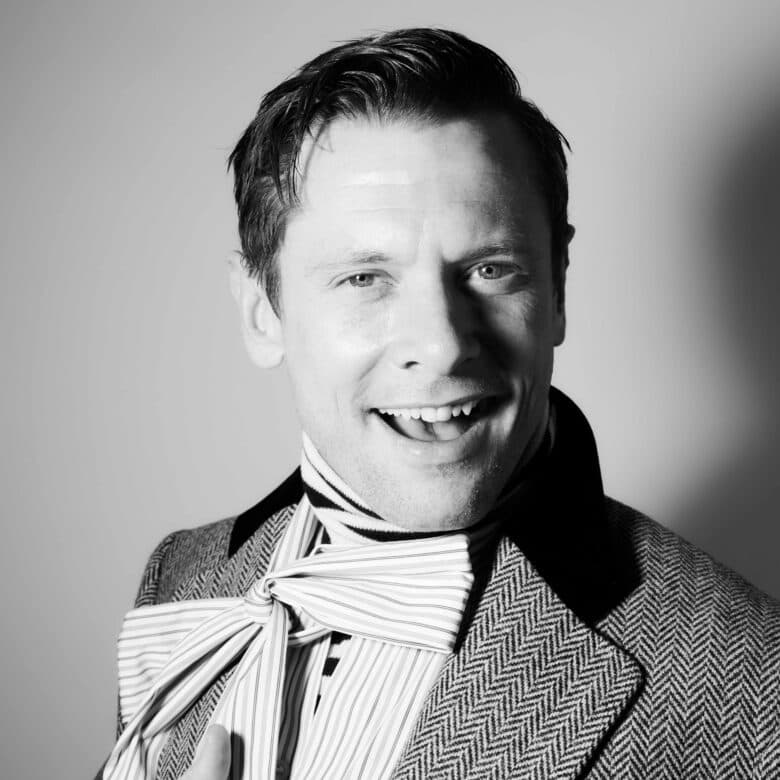
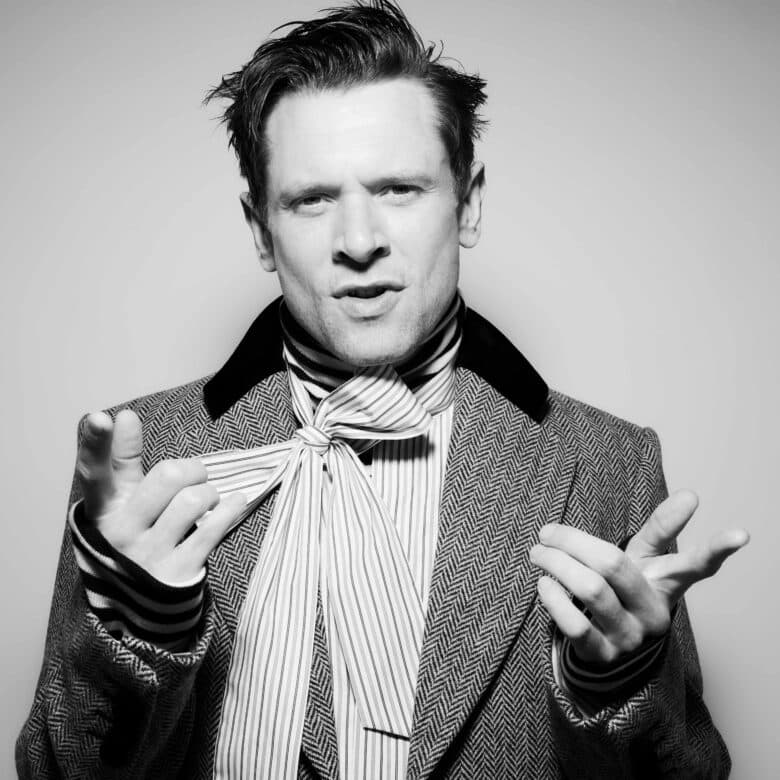
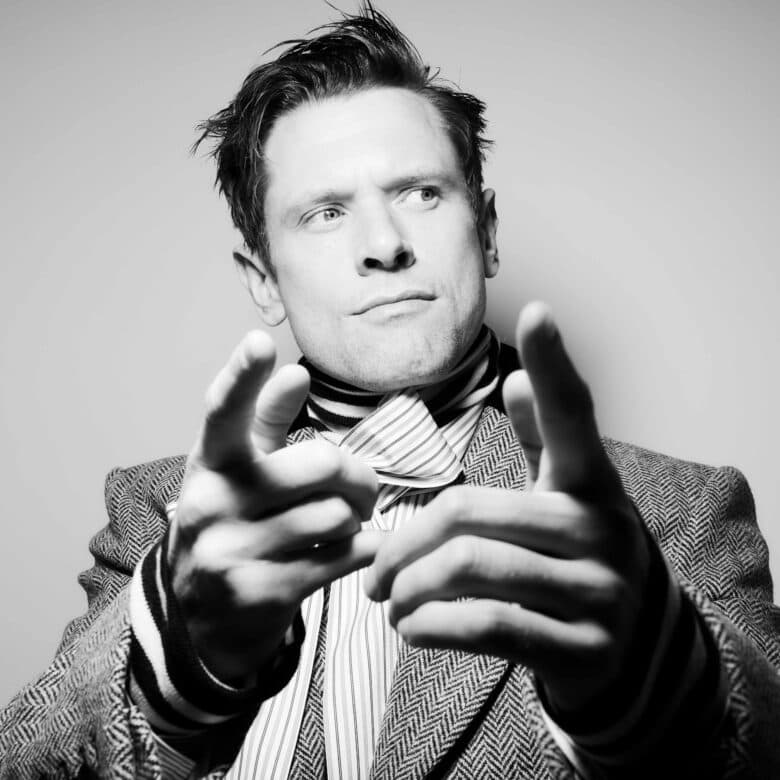
Shouldering the mantle of Sir Jimmy Crystal provided O’Connell with the opportunity to work with two more auteurs — Danny Boyle, who directed the new trilogy’s first film, and Nia DaCosta, who took the helm of its sequel. Although the films are grounded in the same grim reality, the methods through which the directors conjured their worlds diverged. “Danny is very famous for being a pioneer with his choice of camera. There’s a fluidity to working with him,” O’Connell says. “I’ve only had the one experience working with Nia — there was a lot more Steadicam. You’re aware of where the cameras are.” Where the pair coalesce, though, is in the way that they take the reins of their productions. “They’re on set, they’re by the cameras, they’re in-and-amongst it,” he says. “They’re not tucked away somewhere, screaming notes at you through a PA system. They’re in it with you, start to finish. It doesn’t matter if it’s 6am on a night shoot, they’re right there.”
“One very beautiful thing about this job is you’ve never just cracked it.”
The release of 28 Years Later: The Bone Temple will coincide with the twentieth anniversary of O’Connell’s first onscreen appearance — and it feels as though it marks another new phase of his career. “One very beautiful thing about this job is you’ve never just cracked it,” he says. While he’s confident in the work that he does, there’s also room for nervousness, both in the lead up to a new job and as any actor looking ahead. “It’s self-employment, isn’t it? Essentially, we’re freelance — and it’s a gig economy. Unless you can say, hand on heart, I’m going to be working for the next three, four, five, ten years, it’s fucking near impossible to plan for the future.” Although there are many downsides to the precarity, O’Connell can see the cup as half full, too. “If you can afford to fucking relax and feel happy in the quiet times, there’s great excitement to be had in the not knowing what’s around the corner. It’s not easy, but it’s part of the joy.”
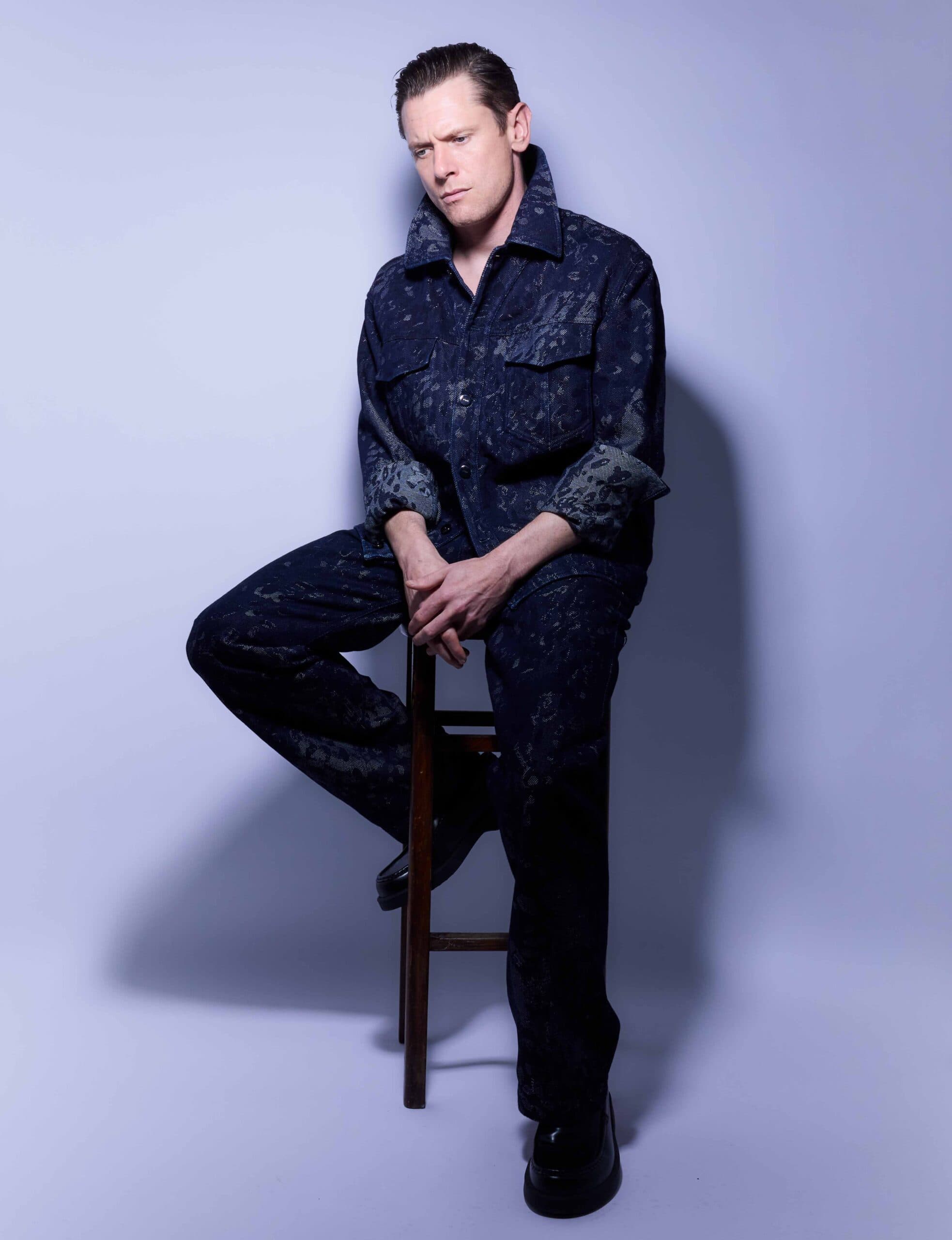
But when it does come to thinking what’s around the corner, O’Connell is intent on making the kind of decisions that will define his legacy. “All of my favourites — all of my sort of heroes, if you will — really came into their own in this sort of period of their lives,” O’Connell says, “That’s what I’ve been quite ambitious about lately, trying to get that career-defining work.” His roles in Sinners and 28 Years Later: The Bone Temple have already started to define his next arc, but for O’Connell, it’s just the start. “I hope to collaborate with great filmmakers, that’s the dream. The list is long,” he says. As our call comes to a close, I push him for some names — but, as ever, Jack O’Connell keeps his cards close to his chest. “What I will say is that I’m working with a few of them at the moment. People that I’ve regarded to be my heroes.”
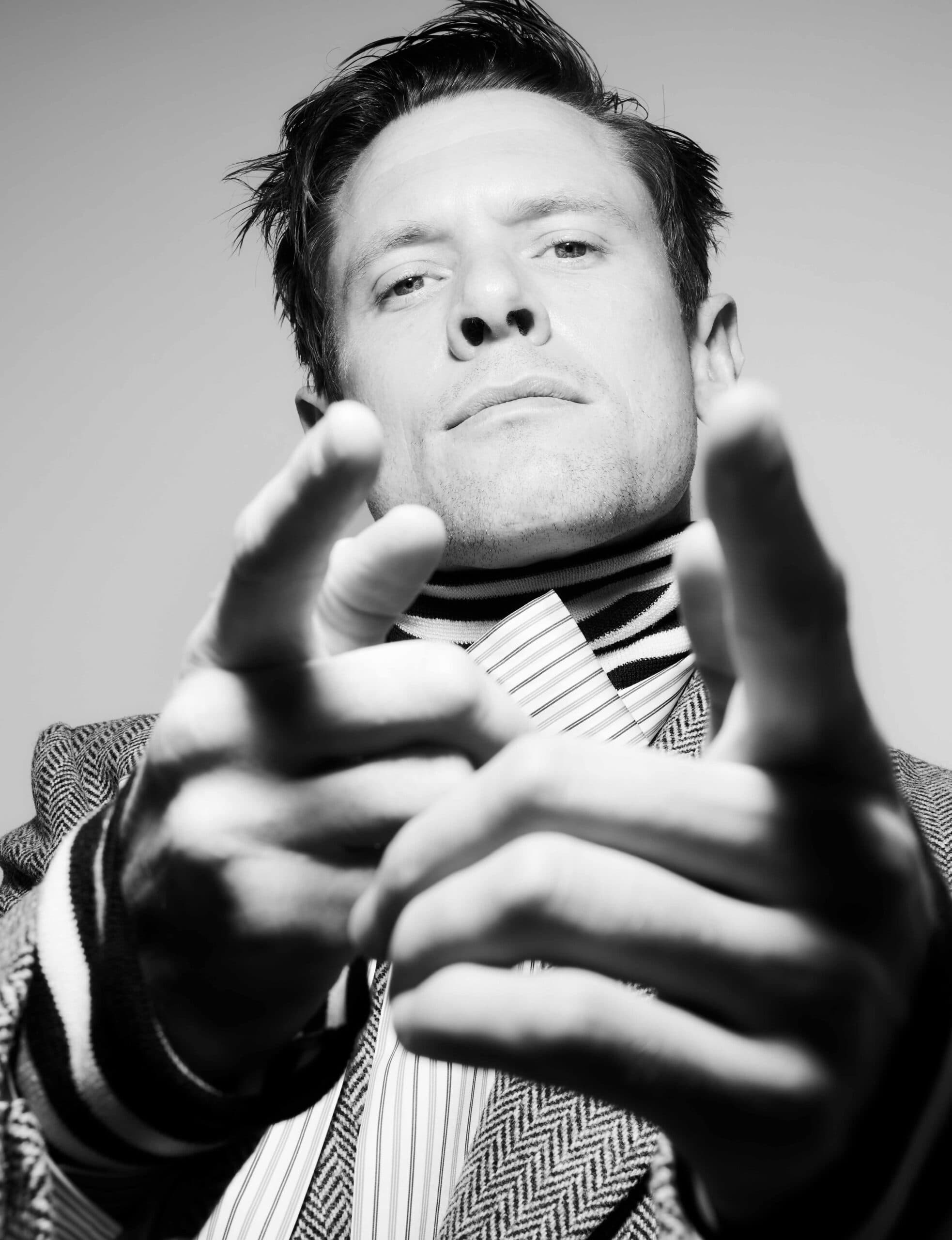
- PhotographerRankin
- Fashion DirectorMarco Antonio
- WriterRob Corsini
- GroomerJody Taylor at Leftside Creative using Babyliss Pro