5 minutes with Planet Giza: The Montréal rap trio blending rap, R&B and brotherhood
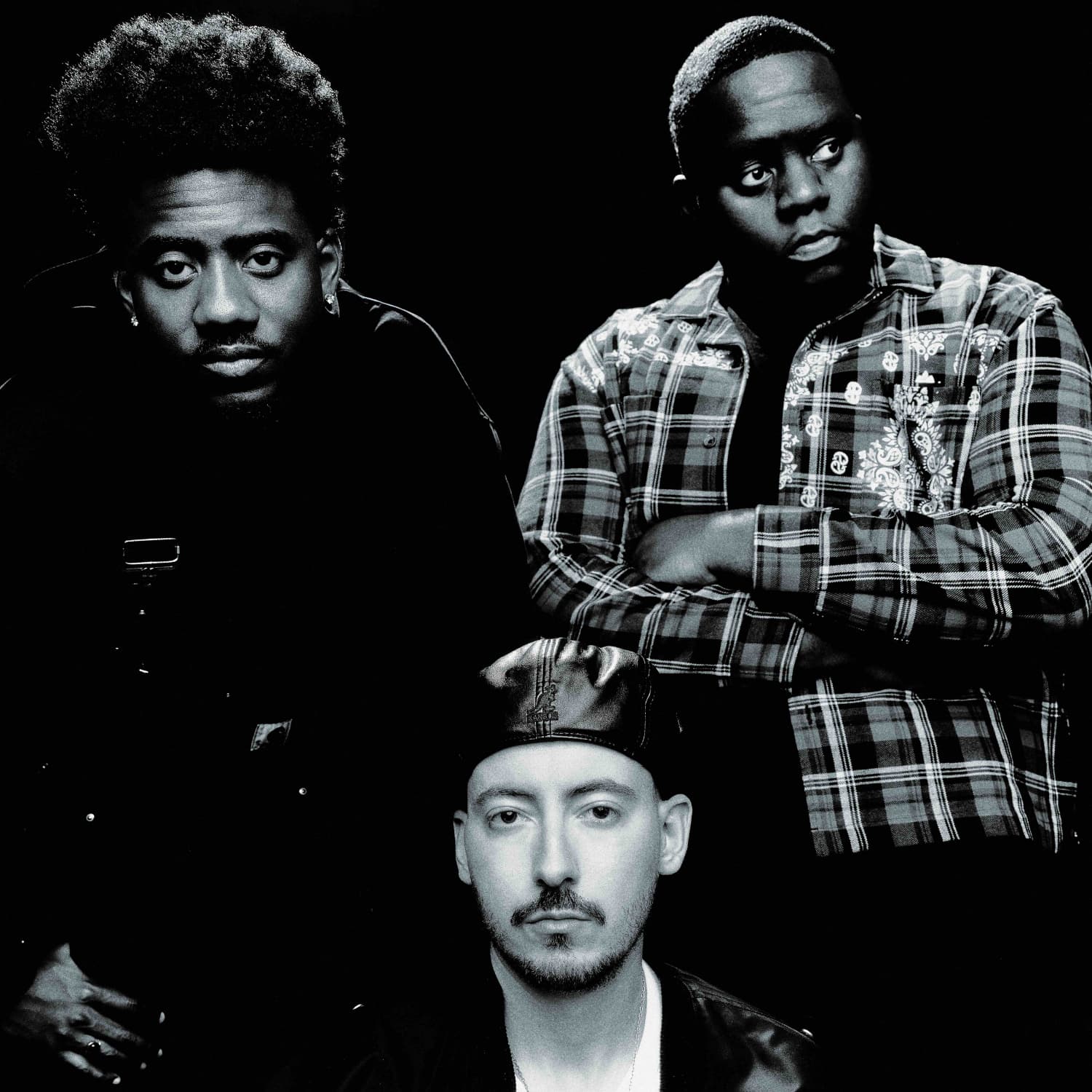
When Rami B picks up our Zoom call, he’s exactly where Planet Giza’s records suggest he’d be: chilled out on a slow Saturday, coffee in hand. “I just woke up an hour ago,” he laughs. The mood is easy, but the thinking is sharp. Very Planet Giza. The Montréal-based rap trio leans into memory the way some artists lean into nostalgia, mining their own biographies and the half-forgotten DNA of early-2000s rap-R&B hybrids. It’s music built for backseat confessions and late-night bus windows. Toughness and tenderness breathe in the same bar.
This palette lets them time-travel without getting stuck in the past. Instead of mimicking an era, they distill it, folding those influences into something that feels unbothered by trends and weirdly resistant to the present moment’s churn. Fittingly, their new project, The Sky Is Recording Me: 100 Years Later, Vol. 3, closes out a three‑part EP series that’s less about chasing a moment and more about building a world.
Your new single ‘The Fall’ has been stuck in my head for days. You’ve called it a song about resilience. What were you actually pushing through when you wrote it?
Tony Stone: I was just thinking about everything I’ve been through and how much I’ve grown. Past mistakes, relationships, friendships, things I might be regretful of. For the second verse, I went to the park and told myself, I’m just going to sit down and feel. I looped the beat over and over, and those were the words that came. It was less me trying to be clever and more me being honest with myself.
Rami B: We didn’t write the lyrics, but we definitely feel it. We’ve all been through stuff. Whatever story Tony puts on the record, we relate — especially with that song.
TS: What’s funny is we started that song in LA while we were working on the project. I actually forgot about it. The guys brought it back like, You already got the hook, and it’s crazy. I was like, Oh wow, you’re right, and kept going from there.
The Sky Is Recording Me feels really cinematic, almost like its own universe. What story does the trilogy tell about where you are now?
TS: It really tells the story of growth. It’s about intentionality. We’ve always been intentional with our music, but on this one, we really hone in on being real, being authentic, being grown. I love that we did it in volumes because it reminds me of Jay‑Z’s sequencing — one, two, three — you feel the chapters of a life, not just a playlist.
Did that feel exciting or stressful playing with that structure for the first time?
RB: Both. At first, it was supposed to be four volumes. We were like, Nah, let’s finish it with Vol. 3 and we put six songs on the last one. The idea was simple. People consume full albums so fast now. A week, maybe, and they move on. We’re still building, so dropping one big album didn’t make sense. Doing it in parts meant we could stay present all year and also force ourselves to focus on quality over quantity.
You all touched the production. On Volume 3 specifically, what sound or decision feels like the clearest sign of your growth?
RB: Instrument‑wise, it’s still us — piano, sax, all that. We’ve worked with musicians before, but it’s the first time we’ve brought in people who are really known for that lan:, Kiefer, Braxton Cook, Elijah Fox… jazz is their world. I don’t know if that’s exactly what makes it sound “grown”, but it definitely adds a different weight.
TS: You can hear it on ‘The Fall’ when the bridge opens up, and the sax comes in. That’s a very different musical choice from our earlier stuff.
DoomX: We’ve always liked those textures, but we never incorporated them at this level. Working with guys like Kiefer, Braxton and Elijah pushed us into a new dimension, for sure.
The trilogy opens and closes with those spoken‑word skits. In the intro you talk about “time being a feeling”. Has time changed the way you approach music?
TS: Time is the only thing we can’t get back. We’ve been making music for over a decade now. You sit there and think about the time put into this. What are we really trying to say? What do we want people to feel? Those skits were me wanting to acknowledge both our time, and the listener’s time. If you’ve been listening to us for years, that matters to us.
Tony, as the voice of the group, how do you translate Rami and Doom’s “sonic world” into words?
TS: There’s a lot of trust. I’ll do most of the writing, but I’m never above hearing, Yo, that line’s not it, change it. They’ll say that to me and I appreciate it. When a song is finished, it’s never just me rapping — it’s everyone’s contributions and everyone’s standards in there.
D: People don’t always realise Tony produces, too. A lot of times he brings the seed of an idea. Sometimes it’s Rami, sometimes it’s me. Whoever brings the vision, the other two push it to one hundred percent. We’re all following the best idea in the room.
RB: We’ve been doing this for more than ten years. We don’t ask if Tony is going to get it. We just make the music, he gets the subject, we agree, and he runs with it. It’s really that simple with us.
It sounds like there’s a bit of telepathy going on in the studio.
TS: We’ll be freestyling ideas and someone will suggest a harmony I was literally about to sing. Doom will be like, Do this one, and it’s the exact note in my head.
RT: You’ve talked before about Montréal being both a bubble and an engine. After touring Europe, has home started to look or feel different?
D: From a young age we knew we wanted to make it out of Montréal. It’s full of crazy talent, but it’s small, and for a group that makes music in English there’s a political side to that, too. We love the city, but we never felt like we were meant to stay only there. Touring just showed us we were right to think bigger. This music belongs in other places too.
You blend rap, jazz and R&B so naturally that people hear everything from D’Angelo to Kaytranada in there. Who actually shaped your ears coming up?
RB: When I was a kid it was whatever was on MTV, Nelly, Busta Rhymes, and this Montréal channel called MusiquePlus. Then I went into backpack rap. From there I got into older hip hop. So I’d say Busta and Tribe were big for me.
D: I was the opposite. Up until like seventeen, I was straight trap and Dirty South — Gucci Mane, Outkast — plus whatever was big in hip hop. My palette really opened up when I started making music with other producers: Tony, Rami, The P, Kaytranada.
TS: In the car my dad would play Michael Jackson, Luther Vandross, Donna Summer, Kirk Franklin. Biggie was my first introduction to rap. Later Jay‑Z, Outkast… then I discovered D’Angelo and that changed everything.
D: But we don’t try to emulate anyone. What we’re doing as a group hasn’t really been done like this. We’re carving our own lane.
You’ve said you never want to repeat yourselves. Was there any risk on this project that you almost pulled back from?
RB: There was another tune with Kiefer that we decided not to put out — it just didn’t feel right.
TS: I didn’t want to force myself to write it. That’s one thing about us: we’re big on quality control. That’s why an album can take one or two years. Not everything is meant to be heard right away.
If you could curate a Planet Giza night anywhere with three acts on the bill, one venue, what does it look like?
TS: I’ll let the guys answer this one — all I’m asking is to perform two or three songs.
RB: I’m including us, obviously. All the people I want to choose are dead! If that’s okay, I’d say Roy Ayers.
D: That’s a crazy start. For the last act… bring back Michael Jackson. Us, Roy Ayers and Michael, in the middle of Tokyo.
- WriterRoisin Teeling