Sound the alarm: In conversation with Pussy Riot’s Nadya Tolokonnikova
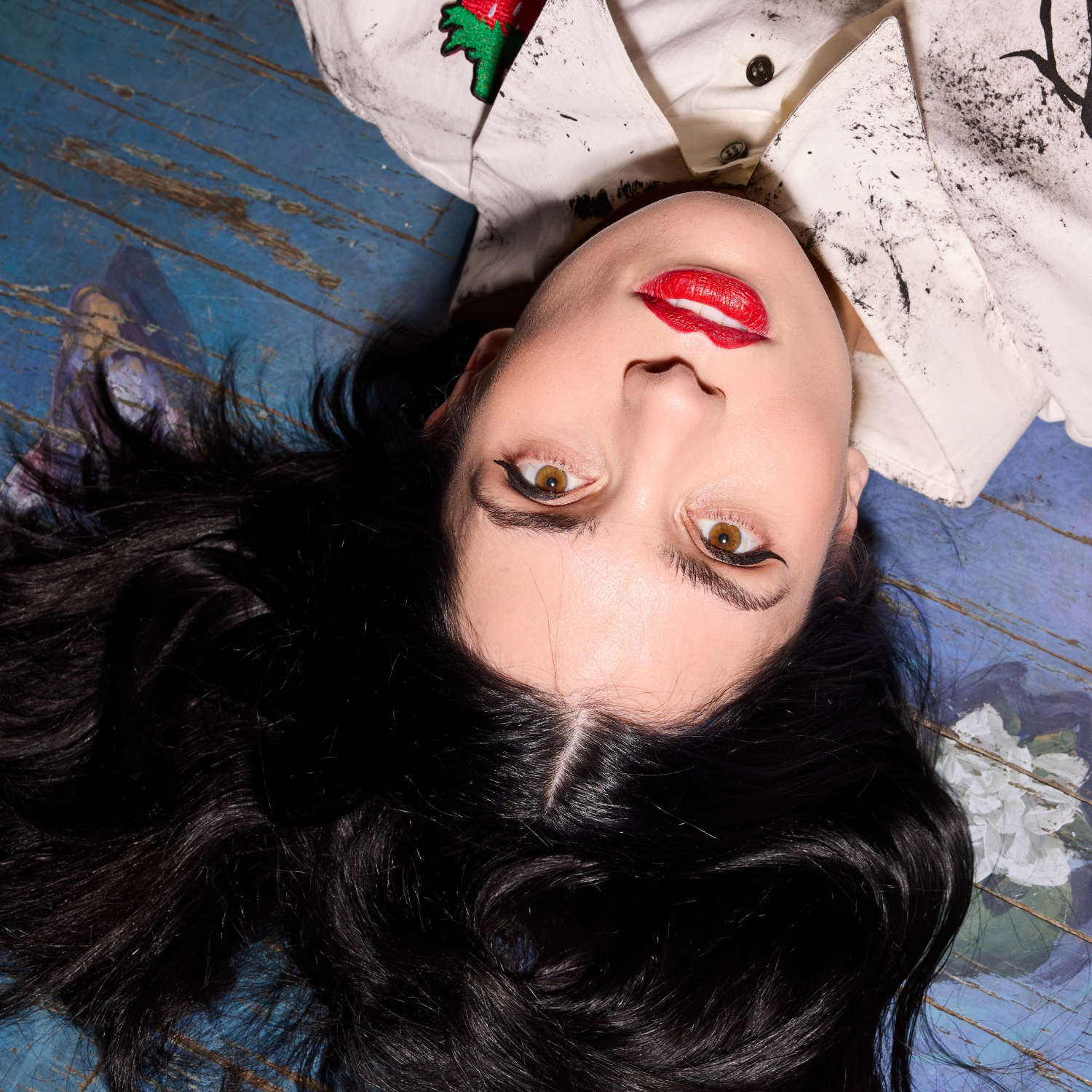
“It all started with Donald Trump winning the presidential election,” Nadya Tolokonnikova divulges. Over Zoom, anonymous behind a voluptuous, full-lipped, cyclops profile photo, the Pussy Riot frontwoman is soft- spoken as ever. That is, to describe her tenor rather than the ferocity informing her every answer. We pick up where we left off, our last conversation having occurred in 2023. While only a couple of years separate our prior correspondence and today’s, it is as if we now exist in an entirely different realm. In many ways, we do: each of us individually, as well as the surrounding world and its population. What then loomed as a generalised, abstruse threat of global autocracy now delivers daily blows to the tenets of democratic conduct. The shift is marked by Tolokonnikova, not by what she shares, but through what is withheld. “It’s becoming increasingly dangerous to speak your mind. It can have serious consequences.”
The ‘it’ Tolokonnikova refers to is less of an amorphous threat than a revelation, spun from the activist’s reaction to a violently shifting international political landscape. “The day after the 2024 US election, the curator of Los Angeles’ Museum of Contemporary Art, Alex Sloane, wrote to me saying she really wanted me to create something,” Tolokonnikova tells me. “That gave birth to Police State.” Police State is the latest installation and compendium of the performance artist’s repertoire, born of “everything I’ve learned as a political activist and artist in Russia, and everything I’ve gathered about the United States — the state of the world, of Europe, of Iran — [and] the global trend toward authoritarianism.” Police State, Tolokonnikova remarks, is one of her most challenging projects to date. This is coming from a woman who sits on the international most wanted list. She admits the exhibition production was “a lot”. “It’s a ‘total installation’, a term I borrowed from Ilya Kabakov, who inspires me greatly,” the artist explains. “We spent approximately half a year building the entire thing. It recreated the reality of the Russian prison system in great detail, with the addition of some fantasy elements. It’s a surrealist version, generalised about the entire world, not just Russia.”
To commemorate the exhibition, and immortalise its message, Tolokonnikova released a hardcover in December of 2025 by the same name. The book was dedicated as dearly to the survival of the work (and in this case, Police State’s urgent message) as to the living art. “When MOCA closed its doors, we didn’t know if the installation would continue,” the activist says “We persisted showing our art, but more in line with the moment. We took to the street with our banners and brought a group of activists from Los Angeles to participate in the No Kings protest.” Tolokonnikova refers to the U.S.-wide demonstrations inspired by Trump’s encroaching authoritarianism. First taking place on 14 June, 2025, six months after Trump’s inauguration, the continued series of nationwide demonstrations mobilized in non-violence to denounce tyranny.
Much in line with its creator’s own nature, Tolokonnikova’s Police State shook free the shackles that held it captive, freeing itself on the international stage. “The book is more attuned to the current political reality because it was done later,” Tolokonnikova says. “Because we began working on the book in July of 2025, we had more information about what Trump 2.0 looks like.” Police State compiles photographs of the bedlam surrounding Los Angeles’ MOCA during the Police State exhibition’s run, which coincided with Trump’s early ICE deployments and worldwide protests against the administration. The hardcover is part coffee table book, part account of a revolution. “There is graffiti that we photographed throughout the city, like ‘ICE is Pussy’ and ‘It’s Beginning to look a lot like Russia’. There are portraits of the LAPD and National Guard that we shot while participating in protests. It not only chronicles the installation, but the interaction of the installation with current climate — this surreal moment when the art broke from the walls of the museum, growing further to surround the institution of MOCA.”
Tolokonnikova’s early activism was cultivated within Voina, a performance art collective protesting Putin’s regime. It was in this career infancy, when she was arrested for ‘hooliganism’ rather than in exile for ‘extremism’, that Tolokonnikova began shaping the ideology: “this art is a weapon”. As the catchphrase matures, it only grows more relevant. Tolokonnikova straddles refugee status as Putin closes borders on Pussy Riot and its affiliates. “Most of us still have family members and close friends living in Russia, who can’t leave for a number of reasons,” the artist tells me. “Living in exile is already filled with uncertainty, but we have also had to deal with these people being targeted or poisoned.” The weaponisation of art is often the only defense Tolokonnikova has left in the face of Pussy Riot’s 16 December designation, when they were officially labeled an ‘extremist group’. “We’re not terrorists quite yet, though I think that’s coming,” the activist giggles. “We turn it into a joke, but daily life can be quite annoying when you’re an enemy of the state. It’s a conditional layer of complexity that we didn’t ask for. It comes with the territory.”
“Daily life can be quite annoying when you’re an enemy of the state.”
While the map shrinks before Tolokonnikova’s eyes, she is all the more undeterred by her difficult living situation. On the contrary, the acrid sting of (and pride for) Pussy Riot’s recent relinquishment has sharpened her coolly keen observations of the tyrannical systems at play. “Every country has its own quirks,” she begins sardonically. “Apparently, in America, you can get shot for just being in the street, so that’s fun. In today’s Russia, you totally can get shot for no reason, because they are in lawless territory. That would happen to me if I ever went back.” Tolokonnikova fled Russia to escape the flagrant cruelty imposed by Putin’s rule. Yet, the tenets by which Russian rule abides are eerily seeping into formerly benign countries, trailing her across the globe. “But, when I think about Russia in 2011, when we began Pussy Riot, there was an illusion of protection. Generally, cops in the U.S. have much more of a proclivity to use a lethal weapon than in other territories, and that’s scary.” Force, no matter its lethality, holds no power over Tolokonnikova’s ambition, nor can the threat of it make her shrink. “I don’t care about physical safety,” she exclaims. “I care about making good art. I want to build a broader coalition. Life is finite. It will all end at some point.” Dauntless as she is, Tolokonnikova’s seeming-nihilism is more indicative in her eyes of a life lived purposefully. “If life has to be shorter, at least that intensity will be there. I’m not into preserving the safety of my physical body for the sake of preserving it.”
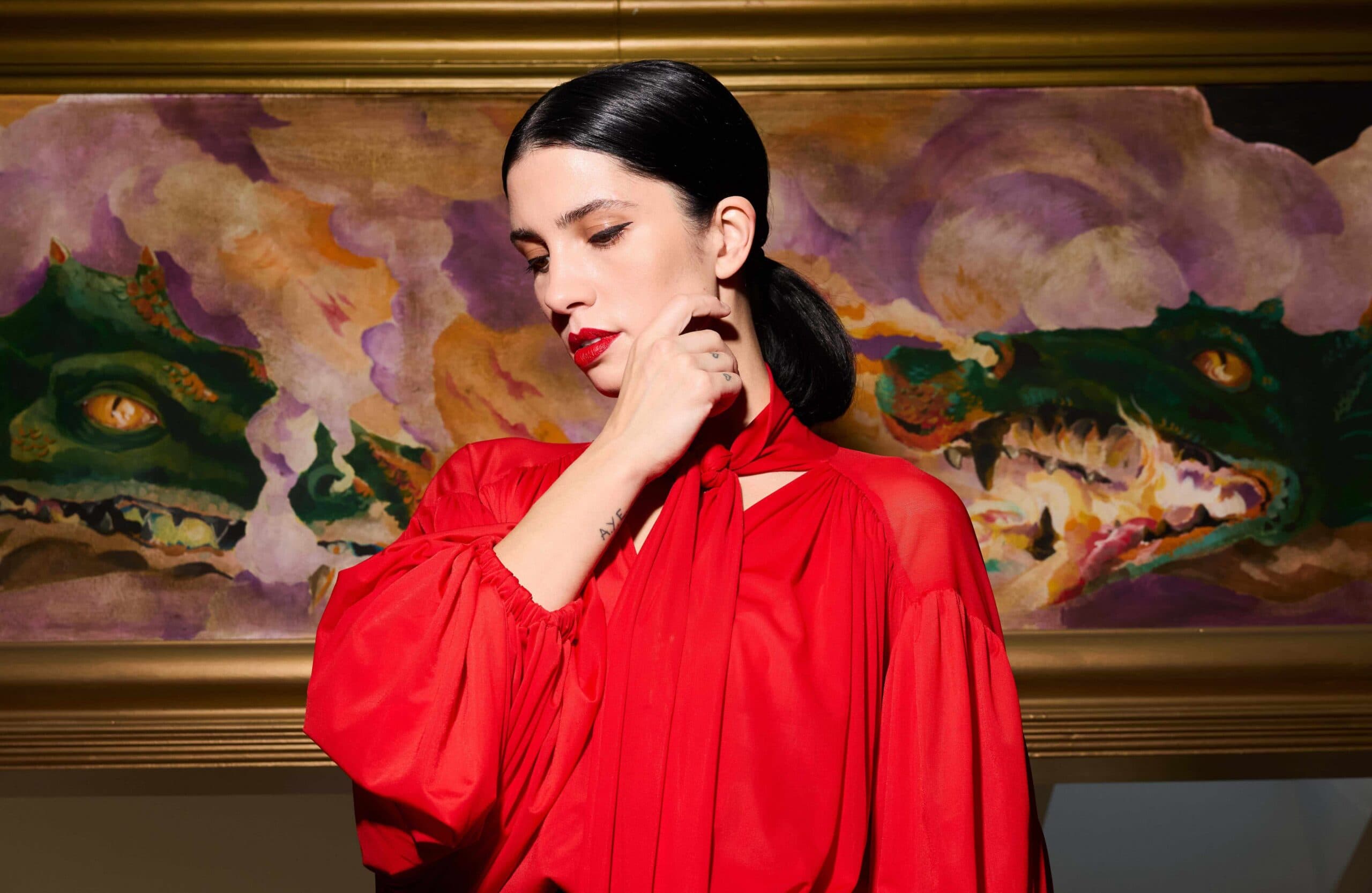
Rather than hinder the revolutionary, every provocation — governmental, cultural, personal — pushes her art beyond the confines of museum installation into a more expressive medium. After nearly a decade of penning music, Tolokonnikova is set to release her debut solo record come spring. “Cyka is a potential name for the album, which is the Russian word for ‘bitch’, and the name of one of the songs I am really stoked about,” the artist tells me “I don’t know if English-speaking people are going to be stoked, because it’s Russian rap, so it’s a bunch of words that make no sense to you.” Despite Tolokonnikova’s humility, her tracks transcend language. The artist has been making music since Pussy Riot’s 2011 inception, both within the group and on her own solo tracks. The titles, easily understood by English-speakers, denote such hits as ‘Putin’s Ashes’ and ‘HATEFUCK’, off of the 2022 MATRIARCHY NOW record. The grit and insistence of her voice commands listeners to pay attention, to do something, irrespective of dialect. Her passion, both for message and craft, is palpable. “I’ve produced this song myself,” the artist says “I call the track ‘a collaboration with Putin’, who is featured talking about Pussy Riot. He’s so ashamed to say those two words: ‘Pussy’ and ‘Riot’.”
The album arrives, a psychedelic scrapbook of political dissonance, a nightmare-scape of Kremlin militarism punctuating the heady beat and intoxicating lyrics. “I also used samples from a TV show that was released while I was in jail” she adds. “It’s typical Russian propaganda. They were calling us witches and prostitutes. They claim we were hired by the West to destroy Russian spiritual values.” When regarding Tolokonnikova’s lore as a Russian dissenter, sometimes the truth is stranger than fiction. She is no stranger to demonisation, in the most literal, Biblical sense. “They brought a priest to the television studio where they were filming this show. He ran around sprinkling everyone with Holy Water to save them from us. It’s a very absurdist, theatrical performance.”
Tolokonnikova is a singular architect forging this genre, culling the bravery lacking inthose twice her size and age to speak against “censorship in Russian music”. “Russian rappers of today pretend they’re gangsters, but they can’t talk about anything: politics, drugs, sex,” she explains. “The law is retroactive, so these people also have to go back and censor all of their old music. It’s fucking rap: 80 percent is about drugs, so it is ridiculous to listen to those old records.” Of all hypocrises mentioned throughout our conversation, Tolkonnikova is the most unabashedly disappointed in these former thugs, mincing no words as she mocks their feigned personas. “Some of the rappers who turned pro-Kremlin in the last ten to fifteen years, who started as gangster rappers, have to remove their entire albums. No one has the balls to speak out. They still pose with the guns and the ladies, like they’re so cool. I’m thinking: ‘Jesus fucking Christ. You are losers. You haven’t done one percent of what I have done to actually be a gangster.’”
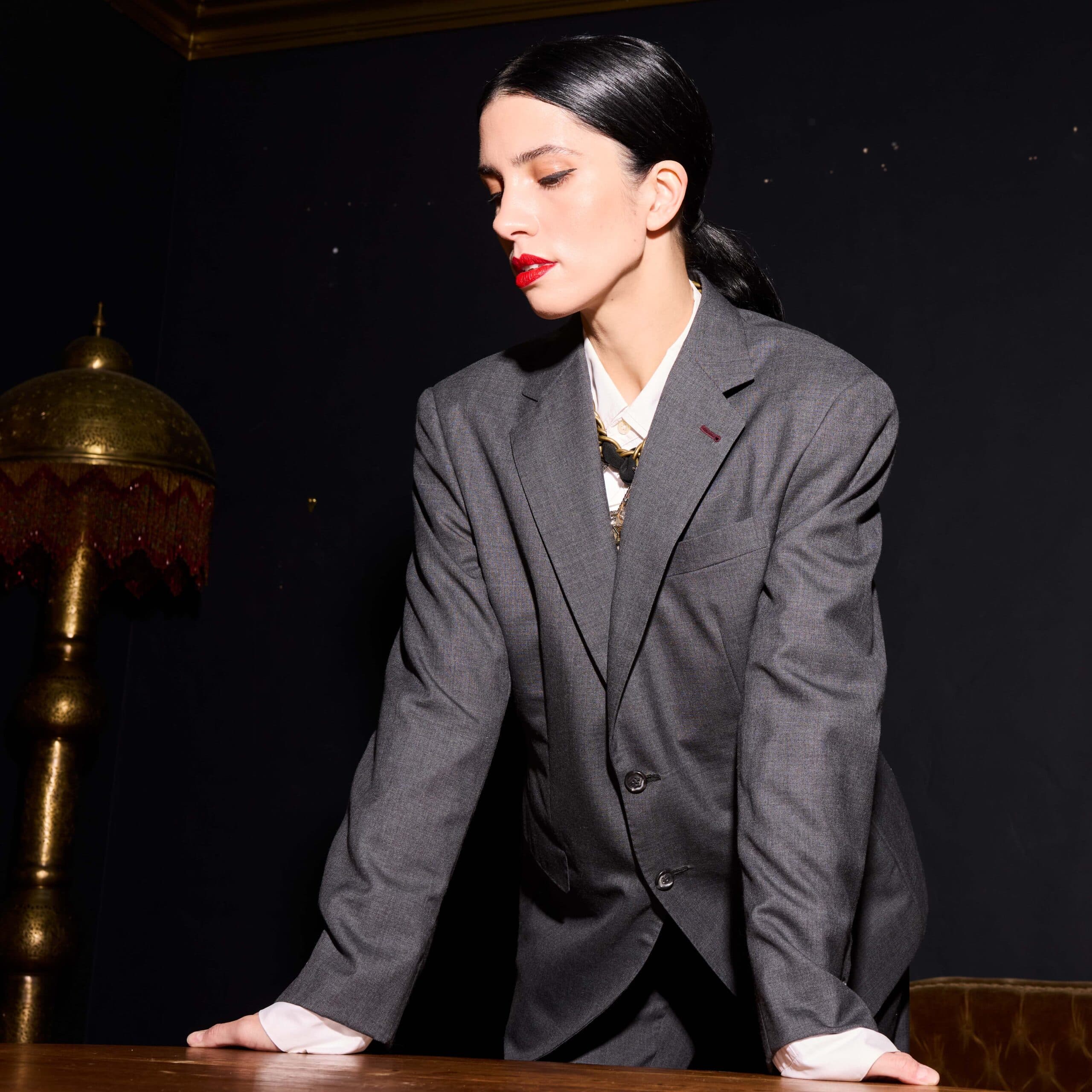
How does Tolokonnikova remain steadfast, even indomitable, in her “gangster” ways? Surely, the anti-socialism necessary to sustain her lifestyle would eventually grate on the steeliest of individuals. Given that Tolokonnikova’s empathy oozes through the screen, indifference is out of the question. It’s impossible to ignore that her anchors, the radically like-minded women of Pussy Riot, are the integral hype-women behind today’s premier revolutionary. “We have each other, and that means a lot,” she says. “My comrades don’t bow down to any authority. They laugh it off. You can’t be a pussy when you have people like that around you. You want to be on the same level with them.”
“You can’t be a pussy when you have people like that around you.”
When asked what lies ahead, Tolokonnikova’s response is decisive, but broad: “Only expanding, that is the only way to go.” More specifically, she is focused on the international dispersion of Police State, beginning in the place where it matters most. “I hope to bring Police State to New York, and that it won’t come with all of the fun things Trump promises to bring to whichever city I choose to post an exhibit,” Tolokonnikova retorts. Much to her chagrin, the stifling presence of armed forces looms just as large at her showings as that of awed patrons. “We were thinking of posting in Chicago, before it was raided with National Guard and ICE troops. Mamdani will save New York, though, so I’m less worried. There will be a solo show in Germany, and museum shows coming to Europe in 2027, but that is all I can say for the moment.” Tolokonnikova later adds she has joined PACE, the Parliamentary Assembly of the Council of Europe, in Strasbourg for their winter session. She punctuates an esteemed group of Russian Democratic Forces, gathered to foster dialogue between Russian individuals in exile and the Assembly. This internationally significant work with PACE aims not only to bring justice to intra-Russian crimes against humanity, but to foster peace in Ukraine, Europe, and beyond. When asked where she is headed on the heels of her profound efforts in Strasbourg, Tolokonnikova coolly muses, “I’m going to continue working on my physical art, in a world where people are so constricted. It has been an interesting developmental step as a performance artist: How do you encapsulate that same intensity of physical art in an object that is able to travel further than you are?”
- PhotographerRankin
- StylistJules Wood
- WriterDelaney Willet
- Hair Stylist and Make-Up ArtistKirsten Bode at Artofficial, Stockholm using KÉRASTASE and DIOR Beauty
- Photographer's AssistantAsh Alexander
- Fashion AssistantLouis Wright
- ProductionQuynh Stanley
- LocationThe Frank Zappa House, Hollywood Hills