Isabel May is Gen Z’s final girl

Isabel May wants to swim with sharks. “I am fucking terrified of them,” she says, smiling in a way that suggests the fear is exactly the point. “Jaws screwed me. And yet, I think I’ll probably discover that they are really magnificent creatures and, when I get close to them, I’ll look them in the goddamn eye and tell them, ‘I’m not scared of you’.” For the Scream 7 star, fear is not an obstacle,
but her greatest tool. It’s hard to reconcile this philosophy with the girl sitting opposite me on Zoom. With a fawn-like face, dark lashes fanned over warm brown eyes and freckles scattered across her skin, she speaks thoughtfully, as if weighing each word before letting it land. There is nothing brash about May and yet, beneath that softness, is something flint-like. A ferocity.
Nevertheless, the 25-year-old admits that she is deeply sensitive — to music, to other people, to the emotional strain of becoming someone else when acting. It is only through this, however, that her bravery can be revealed. May doesn’t numb herself to discomfort — she uses it to give gravitas to her experiences and respect to the emotions they induce. “If something scares me,” she says, “I think it’s worth trying once. Because maybe it won’t scare you anymore. Maybe you’ll want to do it again. And if you don’t, fine. But at least you did it.” It’s a philosophy that has shaped not just her life, from jumping out of planes in Switzerland to traveling the world solo, but also her career — from the windswept Western of 1883 to the psychological terror of Scream 7. May has made a career from entering worlds that demand emotional extremity, but the difference now is she has learnt how to face it.
She harks back to filming the 2021 series, 1883, when she would purposely sink into despair for days, refusing to let herself resurface. She used music as a kind of emotional trapdoor, building playlists that became portals into her character. “I wouldn’t let myself come out of the emotion,” she tells me. “I was afraid I’d lose it.” The result delivered her luminous and devastating performance as Elsa Dutton, but the method was draining and unsustainable. By the time she stepped into the blood-soaked world of Scream 7, May had evolved. “You can convince the body it’s experiencing something it isn’t,” she explains, describing a newer, more precise approach. “Breathwork, and imagination. I wait until the last possible second to drop into it. I need the energy to sustain it. And then I want to get out of that emotion as quickly as I can.” Horror, particularly a film as self-aware and culturallyembedded as this franchise, demands endurance. Even May couldn’t live in a state of cortisol for weeks on end.
“If something scares me, I think it’s worth trying.”
In Scream 7, the actor steps into the role of Tatum and the legacy of the ‘final girl’ — the archetype anchored by Neve Campbell’s Sydney Prescott. “I had never seen the franchise before,” May admits. “So I came into it without all the tropes in my head, which gave me a freshness.” The ‘final girl’ has historically been the last woman standing, the moral centre and survivor, but May isn’t interested in playing tropes. This new iteration is about inheritance. The film, developed by Kevin Williamson, explores generational trauma — a daughter shaped by the violence and resilience of her mother. And so, rather than leaning into a Gen-Z caricature in this role, May wanted to bring something new: a young woman desperate to connect and understand, and prove she is strong enough to carry what came before her.
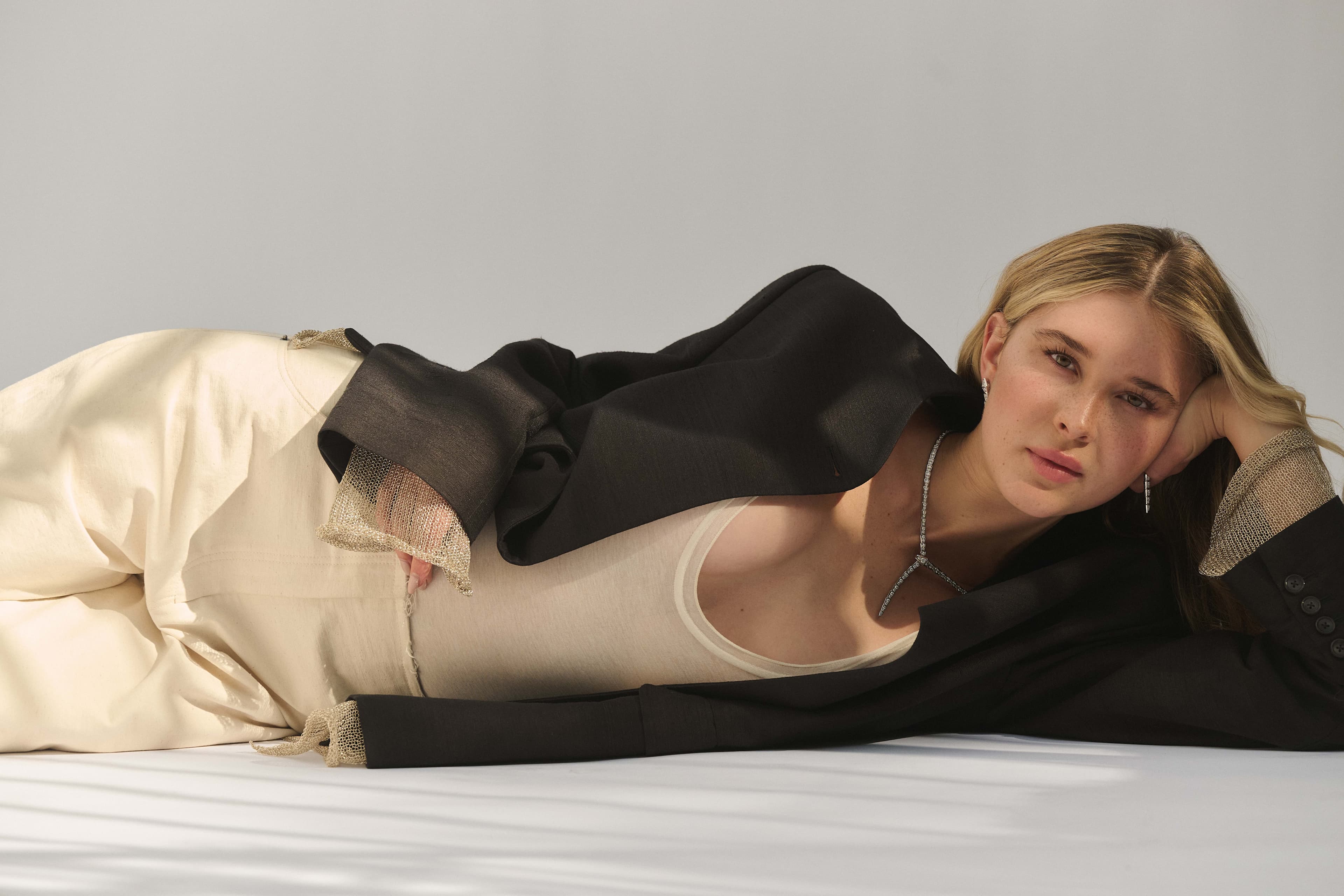
“I think that, for my character, Tatum, she symbolises this new generation,” May says. “Maybe she inherits trauma and the past transgressions of what’s happened to her mother, and now it’s going to happen to her in some ways. But she can also adopt that strength that Sydney has and push back.” The actor continues: “I think push back with even more confidence and more resolve, because our generation today doesn’t take no for an answer.” If May is setting the precedent for a new era of ‘final girl,’ the actor is clear about what she hopes to achieve: “Unrelenting resolve in oneself. Don’t take no for an answer.”
While May’s method of obtaining this has been tempered, music remains her dominant tool for mining emotion. From classical scores to obscure, genre-subverting artists, songs tether May’s mind and body together. “If [the music] is aggressive, I’ll start driving like a maniac,” she says. “If it’s sad, I’ll get depressed.” She laughs. “I have to be careful.” That permeability, so often dismissed as fragility in young women, is, in May’s case, her power. She feels deeply and always has. As a child, she observed her own reactions in real time, filing them away like research for future films. She jokes, “I want no one to know my IQ because it’s probably embarrassingly low. But my EQ, I can say with some confidence, is high.”

I observe that there is something almost old- Hollywood about May’s earnestness — the way she carefully packages her emotions for the screen, as though thoughtfully wrapping them in a Tiffany’s box. “Visibility is part of the job,” she says. “But craft is a priority, that’s what I care about — studying and learning and being a student for the rest of my life.” Last year alone, May moved from Western to horror to operatic melodrama, slipping between an action thriller and a tear-jerker like some kind of studio era star. And it’s a good thing, too. She doesn’t want to be pinned to one genre. “If I stick to one thing, I’ll get restless,” she says, evoking her aspirations of taking on a truly goofy rom-com or a drama that’s almost unwatchably real. She references The Hours and Nicole Kidman’s prosthetic transformation into Virginia Woolf with awe, fascinated by this work that obliterates vanity to deliver something entirely truthful. May knows she can do the same. “Anything you wouldn’t expect me capable of doing,” she says. “That’s what I want to do.”
“My IQ is probably embarrassingly low, but my EQ is high.”
Though her ambition is impressive, I notice that it isn’t May’s most striking characteristic. Rather, it is her selflessness. As our conversation draws to a close, she tells me a story about an Ayurvedic doctor who reframed the concept of prayer: “‘When an ambulance passes, pray for them,’ he said, ‘Prayer is not for yourself, it’s for others’.” May isn’t religious, but the sentiment was lodged somewhere permanently. “It helped me get out of my own head,” she says. In an industry hinged on self-obsession, May’s instinct is to look outward. She talks about her best friend and her parents with reverence, about wanting success for her friends almost more than herself, about perspective, stepping outside her own lens to see through someone else’s.
There’s a temptation to frame May as a contradiction. She is soft and observant, strong but empathetic. But this duality is what makes her the perfect representative for a whole generation of young women in cinema. May is the paragon of a distinctly Gen-Z femininity: emotionally articulate, unashamed of her empathy, unrelenting in her work ethic and absolutely unwilling to apologise for her ambition. May probably will swim with sharks one day. She will probably be terrified. And she will probably do it anyway, because she was made to be Gen Z’s ‘final girl’.

- PhotographerEric Ray Davidson
- StylistCaroline Dejean
- WriterEve Williams
- Make-Up ArtistJo Baker at Forward Artists using BAKEUP Beauty
- Hair StylistCraig Gangi at Exclusive Artists using RŌZ
- Photographer's AssistantGracie Newman
- ProducerAlejandro Restrep